Description
Trientine Supplier from India
Indian Generic Medicines (IGM) is a WHO-GMP-certified manufacturer, supplier, and exporter of Trientine Hydrochloride capsules — marketed under our own brand Triokris™ — supporting hospitals, importers, distributors, wholesalers, and NGOs across global markets with a reliable, compliant supply of this essential Wilson’s disease therapy.
What is Trientine?
Trientine (trientine hydrochloride, also written as trientine dihydrochloride) is an oral copper-chelating agent used in the long-term management of Wilson’s disease, a rare inherited disorder in which the body is unable to eliminate copper normally, leading to toxic accumulation in the liver, brain, and other organs. Left untreated, Wilson’s disease can cause progressive liver failure and irreversible neurological damage.
Trientine works by binding excess copper in body tissue and carrying it to the kidneys, where it is excreted in the urine. It may also reduce copper absorption from the gastrointestinal tract. Trientine is most commonly prescribed as a second-line chelating agent for patients who cannot tolerate D-penicillamine, the traditional first-line therapy, due to penicillamine’s higher rate of adverse effects such as hypersensitivity reactions and bone marrow suppression.
Because Wilson’s disease requires lifelong treatment, and trientine is not manufactured or registered in every country, a dependable international supply chain is essential for hospitals, treating physicians, and patient-access organizations sourcing this therapy on an ongoing basis.
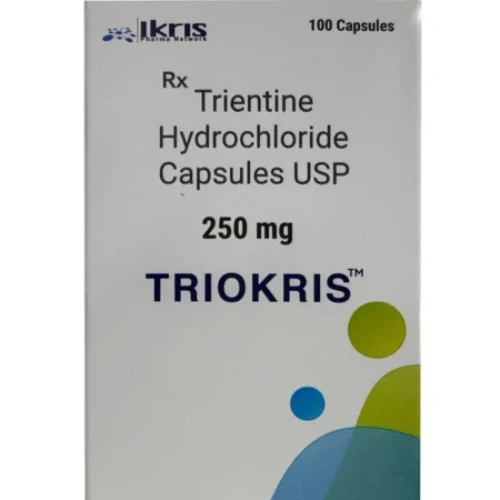
Product Overview: Triokris™ (Trientine Hydrochloride)
| Specification | Detail |
| Generic Name | Trientine Hydrochloride USP |
| Brand Name | Triokris™ |
| Strength | 250 mg |
| Dosage Form | Hard gelatin capsules |
| Pack Size | 100 capsules per bottle |
| Standard | USP (United States Pharmacopeia) |
| Manufacturing Facility | US FDA-approved, WHO-GMP certified, India |
| Shelf Life | 24 months from date of manufacture |
| Storage | Store below 25°C, protected from moisture and light |
| Therapeutic Class | Chelating agent / rare disease / metabolic disorder therapy |
| Indication | Wilson’s disease, especially in patients intolerant to D-penicillamine |
Why Source Trientine from India Through IGM
International buyers increasingly look to India for rare-disease and chelation therapies because Indian manufacturers combine regulatory-grade quality with significantly more competitive pricing than originator brands, without compromising on compliance. Indian Generic Medicines works specifically within this space, and buyers choose us for the following reasons:
- US FDA-approved, WHO-GMP certified manufacturing: Triokris is produced in a facility that meets the quality standards required for regulated and semi-regulated export markets alike, giving importers confidence in batch-to-batch consistency.
- Complete export documentation, prepared in advance: Every consignment can be supplied with a Certificate of Analysis (COA), GMP certificate, Certificate of Pharmaceutical Product (CoPP) or free-sale certificate where required, commercial invoice, and packing list — reducing customs delays at the buyer’s end.
- No cold-chain complexity: Unlike some biologic or injectable rare-disease therapies, Triokris is a room-temperature-stable oral capsule (stored below 25°C), which simplifies freight, customs clearance, and last-mile delivery, particularly to markets with limited cold-chain infrastructure.
- Flexible order volumes: IGM supports both single-patient / named-patient supply requests and bulk institutional or tender-scale orders, so hospitals, government procurement bodies, and distributors can order at the volume that matches their requirement.
- Established rare-disease export experience: Trientine sits within IGM’s broader rare disease and Named Patient Program portfolio, alongside other hard-to-source specialty medicines, giving buyers a single, experienced point of contact for complex regulatory and logistics questions rather than a first-time exporter.
- Transparent, responsive communication: Buyers get direct access to a dedicated export team by phone, WhatsApp, or email, with quotations and documentation typically turned around quickly rather than routed through multiple intermediaries.
Global Export Reach
Indian Generic Medicines supplies Trientine to importers, distributors, hospitals, and government/NGO procurement channels across:
- Asia: Philippines, Vietnam, Cambodia, Myanmar, Indonesia, Hong Kong, Singapore, China, Nepal, Bangladesh, Sri Lanka, Bhutan
Export is always carried out in line with the importing country’s pharmaceutical regulations — whether that means standard commercial distributor registration, hospital-tender supply, or a named-patient / compassionate-access import route where the product is not yet locally registered. Our team will confirm the applicable pathway for your country before finalizing a quotation.
Regulatory Documentation We Provide
To support a smooth import process, IGM can furnish the following with every Trientine export order, as applicable to the destination country:
- Certificate of Analysis (COA) for the specific batch
- WHO-GMP / manufacturing site GMP certificate
- Certificate of Pharmaceutical Product (CoPP) or Free Sale Certificate
- Commercial Invoice and Packing List
- Certificate of Origin
- Product insert / Summary of Product Characteristics (SmPC)
- Import permit support and guidance where the buyer requires it
Buyers evaluating tenders or first-time registration in a new market are welcome to request a full document checklist before placing an order.
Clinical Snapshot (For Regulatory & Medical Reference)
This section is provided for the reference of importing pharmacists, regulatory affairs teams, and prescribing physicians. It is not intended as prescribing guidance for patients.
Trientine is dosed based on the salt form and clinical indication, and dosing is always determined by the treating physician according to local prescribing information. As a general reference: trientine dihydrochloride is typically dosed in the range of 800–1,600 mg daily in two to four divided doses, taken on an empty stomach — at least one hour before or two hours after meals — and at least one hour apart from any other medicine, food, or milk, since calcium, magnesium, and iron can reduce its absorption.
Regular monitoring of liver function, blood counts, serum copper, and ceruloplasmin is recommended during treatment, and iron supplementation may be required in some patients due to trientine’s effect on iron levels. Concomitant use with zinc is generally not recommended without specific guidance. Buyers requiring the complete prescribing information for regulatory submission can request the manufacturer’s product dossier.
Who Buys Trientine from IGM
- International pharmaceutical importers and distributors seeking a consistent, documented Trientine supply for their national market
- Hospitals and specialty pharmacies managing Wilson’s disease patients who require single-patient or small-batch procurement
- Government and NGO procurement programs sourcing rare-disease medicines for public health or humanitarian supply
- Named Patient Program facilitators and patient-access organizations arranging compliant import of Trientine into countries where it is not locally registered